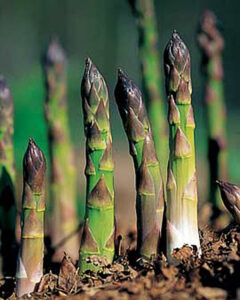
TODAY’S LESSON: Savor the fresh flavor of asparagus! The season’s well under way and will, in fact, be over before we know it. The earliest arrivals of the crop that show up in our markets come from Mexico but I much prefer the local crops that are grown across the United States. Today, we will explore asparagus as a wonderful salad.
WHAT EXACTLY IS ASPARAGUS? Asparagus is a member of the lily family although it bears no resemblance to its relatives in this family which includes onions and leeks. The plant, which is a perennial, produces edible sprouts following its third year in the soil and will continue to produce flavorful asparagus for an addition 6 to 8 years.
ASPARAGUS IN HISTORY: We are not exactly sure of the origin of asparagus but do know that it grows best in regions where the ground freezes in winter to a depth of at least a few inches or more. This would place its origin in probably the cooler climate of Europe. Early herbalists in the first century A.D. found “wild” asparagus foraged was the tastiest and even suitable to be offered up to their gods. Domesticated asparagus has been a “luxury” vegetable throughout history. It was believed that the first cultivated or domesticated asparagus appeared in Greece about 2500 years ago. Emperor Augustus, it is reported, knew the way to get the best flavor from the vegetable by cooking and serving it while it was yet a trifle crunchy.
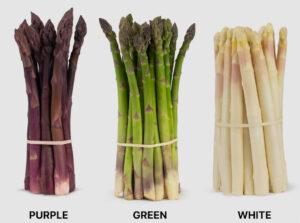
ALL ASPARAGUS ARE NOT CREATED EQUAL: Green asparagus is the common variety in the United States that most people are familiar with. Also if you search there is a “purple tip” green stalk variety that tends to be sweeter than its cousin.
A white and milder variety of asparagus is the predominate cultivated variety in Europe. This variety is blanched or kept white by being mounded to cover with sandy soil as it tries to emerge from the ground to prevent photosynthesis or turning green. The green or white variety is merely a matter of preference.
Wild asparagus is easily found in the rural midwestern states along railroad tracks and along lonely country roads. As a child, my parents gathered wild asparagus with the family for its short growing season although it was many years later when my taste buds caught up to me on this vegetable.
FRESHNESS COUNTS THE MOST: Asparagus is best when eaten just picked as its natural sugars convert to the natural indigestible fibers that make a woody texture and throwing off its taste. These fibers start to form in the skin within hours of picking but may be peeled to remove, a common practice. Just picked asparagus is as tender from the outer skin to the inner core.
NUTRITIONAL ADVANTAGES: There are just 40 calories in 1 cup of chopped asparagus, 20 calories in a six spear serving. Asparagus is high in vitamins C and B6, folic acid, potassium, fiber, folacin, thiamine and glutathione, believed to be an anti carcinogen.
SELECTING YOUR ASPARAGUS: Asparagus is best when picked and eaten as soon as possible. Select crisp stalks with moist, solid stems of the same diameter to ensure even cooking. I prefer smaller more delicate asparagus spears for general cooking but the large or giant thick guys work the best for the recipe that we are making today.
PREPARING YOUR ASPARAGUS: The old rule is to grab the asparagus , with one hand at the base and the other hand at the tip, and bend. The spear will snap at the base of the tender part. However, I try to use all of the asparagus and trim away only the woody part. The lower third of the stalk is good for making soup or an asparagus puree for vegetable pasta, so don’t just throw it out.
THE COOKING BEGINS: Although the asparagus in this salad are served chilled they must first be blanched to enhance their texture and taste. Start with a large pot of boiling water and properly season with salt. After trimming the asparagus tie them into a bundle to ensure even cooking with kitchen twine. You can use the rubber bands that commonly come on them but they tend to crush and mark the asparagus as they soften during the cooking. Plunge the asparagus into the boiling water and cook until al dente, softened but still firm to the
bite, about just 2 or 3 minutes. Remove from the boiling water and immediately plunge into a bowl of ice water to stop the cooking. Allow the asparagus to cool but do not allow to soak in the water; remove and allow to drain. Refrigerate until ready to use.
TRICKS OF THE TRADE: For presentation and to serve this salad at its tastiest, dress the salad at serving time as the acid in the dressing will discolor the beautiful green color.
TRY YOUR TECHNIQUE: Try a simple but beautiful Spring Asparagus with Chive and Citrus Salad to awaken your tastes buds.
JIMMY SCHMIDT ©
SPRING ASPARAGUS WITH CHIVE AND CITRUS SALAD
Makes 4 servings
** Great to Pair a crisp Sauvignon Blanc or Pinot Gris with this salad
48 large asparagus spears, various Green, Purple & White Asparagus are a fun pairing, lower two-thirds peeled, and blanched (32 if they are the giants)
4 cups of baby Spring lettuces, preferably some with red coloration, washed and spin dry
1-1/2 cups Citrus Vinaigrette (recipe follows)
1/4 cup toasted chopped hazelnuts
2 tablespoons snipped fresh chives
Freshly ground black pepper to your taste
1/2 cup shaved Parmesan cheese
1/2 cup Nasturtium Flowers for garnish (optional)
PRESENTATION IS EVERYTHING – Start by placing two asparagus spears from left to right, one at the top of the plate and the other one parallel at the bottom of the plate. Next stack on the ends of the first asparagus, two spears connecting the top and bottom spears, one on the left and one on the right side of the plate. Repeat this procedure until you have made a 2 to 3 inches high box from the asparagus.
In a medium bowl combine the greens and most of the Citrus Emulsion, tossing to combine. Carefully pile the greens into a mound in the center of the asparagus boxes.
Spoon the remaining dressing over the asparagus and artistically around the plate. Sprinkle the hazelnuts, chives, pepper and shaved Parmesan over the salad. Top with garnish flowers. Serve immediately.
Jimmy Schmidt ©
CITRUS EMULSION
Makes 1 1/2 cups
1 cup orange juice
1 lemon, juiced
2 tablespoons raspberry or red wine vinegar
1/2 teaspoon salt
1 cup snipped fresh chives
2 tablespoons roasted and minced shallots
1 cup California Meyer Lemon Olive Oil
freshly ground black pepper to taste
MAKING THE DRESSING: In a small saucepan bring the citrus juices to a boil cooking until reduced to 1/4 their original volume. Transfer to a blender and combine with the other acids and salt. Add the chives and shallots pureeing until they are smooth and the liquid turns bright green. Slowly add the oil allowing it to thoroughly mix in. Adjust the seasonings and reserve at room temperature is using in the next hour or so, otherwise refrigerate.for up to 2 weeks.
Jimmy Schmidt ©
Thank you for the wonderful asparagus info and recipe. Can’t wait to make it
Thanks Fatima. Hope to cook with you soon
Comments are closed.